
Hybrid BPO: closing the last-mile gap

Imagine hiring the sharpest analyst on the market, handing them a mountain of paperwork, then locking the filing cabinets that hold everything they need to make sense of it: the customer records, the policy and contract history, the account balances, the previous claims, the clinical notes, the fraud flags, the master data that says which version of the truth is the real one.

They can read every page. They can classify, summarise, spot patterns and make recommendations. What they cannot do is check a single conclusion against what the organisation actually knows. Is this policy still current? Has this invoice already been paid? Did this claimant lodge something similar last winter?

That, in miniature, is business process outsourcing in the age of AI. The analyst is now a model, and it is very good. It is also working blind.

The BPO market is in the middle of a significant transformation. AI and intelligent automation are changing how work is processed, and customers now expect their outsourcing partners to deliver more automation, better accuracy and measurable efficiency.

Those same customers, particularly in regulated industries, have grown far more cautious about data sovereignty, privacy, cybersecurity, AI governance and external access to sensitive systems. The filing cabinet is locked for good reasons.

That leaves providers in an awkward spot. AI can extract, interpret and recommend, but production outcomes must be grounded against authoritative enterprise information to deliver the accuracy, governance and explainability customers expect. The result is a last-mile gap between outsourced processing and enterprise decision-making.

The last mile

Traditional BPO divides the work neatly. The provider receives documents, transactions or work items, performs the agreed processing and returns an outcome. The enterprise then validates it, adds context, decides and completes whatever happens downstream using its own systems.

That division caps how much can be automated. Providers rarely have direct access to the customer, policy, claims, financial or clinical information needed to validate and contextualise what they have produced.

Enterprises have historically bridged the gap with data extracts or access to selected systems. Each bridge adds integration effort, duplicated data, security exposure and governance complexity. None are popular with a CISO.

AI raises the stakes. Customers want their partners using it, but an AI-generated recommendation is worth little until it has been checked against trusted enterprise data. The provider can process and interpret incoming information, yet still cannot reach the systems required to validate, decide and act.

Close that last mile and grounded, end-to-end automation becomes possible without replicating sensitive data outside the customer's environment. Hybrid BPO is designed to do exactly that: a secure orchestration model that lets intelligent processes operate across both environments while sensitive systems, information and governance stay under the client's control.

The enterprise end node

At the centre sits an enterprise end node: a secure orchestration capability deployed inside the customer's own environment. It creates a governed connection so information processed by the BPO can be enriched, validated and acted on using enterprise data, AI services, business rules and human expertise.

It can start as a simple gateway and grow into a broader platform handling client-side triage, decisioning, workflow and automation.

In practice, four things happen across that boundary. Documents, data and work items move between the two environments through a governed exchange layer that holds the line on security, privacy and data handling. Incoming material is classified, extracted, validated and summarised, with different AI models coordinated according to what each task requires.

The end node then enriches that output using client-side APIs, databases, master data and core systems. An insurance claim can be enriched inside the enterprise using claimant history, coverage, fraud indicators, previous claims and payment status. Triage becomes materially more accurate.

Enterprise rules and controls are applied to the enriched item. Business rules, AI confidence thresholds, compliance requirements, risk scoring, escalation criteria and decision traceability all sit between AI output and any production decision. In a regulated environment, that governance layer is where the game is won.

Finally, the orchestration layer decides what happens next. High-confidence work proceeds straight through into downstream systems. Anything needing judgement goes to an assisted-review workspace with source documents, enterprise data, AI summaries, confidence indicators and recommended actions. People are pointed at the decisions where judgement earns its keep, rather than at everything.
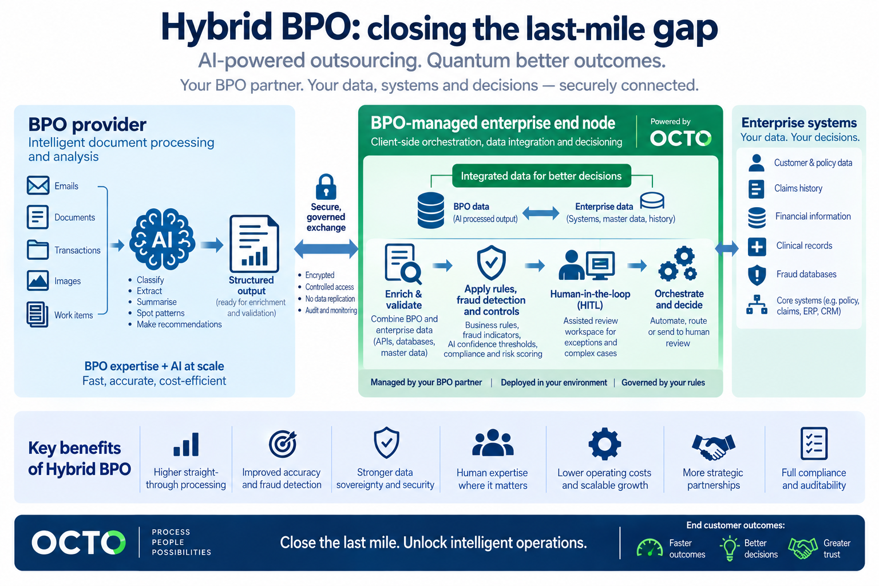
Hybrid BPO Schematic

What it opens up

Once the end node exists, the service catalogue widens: intelligent intake and triage, AI-grounded transaction processing, claims and case decision support, fraud and risk triage, and managed AI-enabled operations.

The commercial logic is straightforward. AI will automate a great deal of what labour-based outsourcing does today. Hybrid BPO is a way to join that shift rather than be flattened by it.

Enterprise grounding also lifts straight-through processing. More work is handled accurately without manual intervention, which means greater volume through existing resources and healthier operating margins.

It defends the relationship, too. As enterprises work out how AI reshapes their operating models, the partners invited into those programs will be the ones offering secure, governed AI without asking anyone to expose core systems or copy sensitive data offshore. Trust follows.

And it expands. A relationship that begins with document processing can extend into further processes and departments.

All of this depends on an orchestration platform rather than a point solution for a single AI, document or automation technology. It has to cover document and data processing, workflow orchestration, business rules, enterprise integration, human-in-the-loop review, auditability and security controls. OCTO, TCG Process's orchestration platform, was built to that specification, and we deploy it with BPO partners on both sides of the boundary - in the provider's operation and as the enterprise end node in the client's environment.

Crucially, not every component has to run in the same place. Processing can occur wherever it is most appropriate while the orchestration layer coordinates the workflow and maintains governance. That suits models where sovereignty, explainability and operational control are critical.

The result is a genuine partnership. Partners bring operational expertise, domain knowledge and scale; customers bring the systems, data and business context needed to ground and complete decisions. The orchestration layer spans both, under agreed governance.

As AI reshapes traditional outsourcing, we believe the opportunity for BPOs is not to process more work, but to create more value from the processes they already understand.

The security boundary between provider and enterprise remains the main obstacle to intelligent operations. Purely labour-based outsourcing will face growing pressure as enterprises automate more work, and customers will look for partners who can combine AI, operational expertise, trusted context and human judgement inside governed processes.

For providers, closing the last mile means more automation, better margins, differentiated services and deeper customer relationships. For enterprises, it means more straight-through processing without surrendering governance or control.

The filing cabinet stays locked. The analyst just gets to ask it questions.

Frank Volckmar is Managing Director, CANZ, TCG Process Pty Ltd.

Imagine hiring the sharpest analyst on the market, handing them a mountain of paperwork, then locking the filing cabinets that hold everything they need to make sense of it: the customer records, the policy and contract history, the account balances, the previous claims, the clinical notes, the fraud flags, the master data that says which version of the truth is the real one.

They can read every page. They can classify, summarise, spot patterns and make recommendations. What they cannot do is check a single conclusion against what the organisation actually knows. Is this policy still current? Has this invoice already been paid? Did this claimant lodge something similar last winter?

That, in miniature, is business process outsourcing in the age of AI. The analyst is now a model, and it is very good. It is also working blind.

The BPO market is in the middle of a significant transformation. AI and intelligent automation are changing how work is processed, and customers now expect their outsourcing partners to deliver more automation, better accuracy and measurable efficiency.

Those same customers, particularly in regulated industries, have grown far more cautious about data sovereignty, privacy, cybersecurity, AI governance and external access to sensitive systems. The filing cabinet is locked for good reasons.

That leaves providers in an awkward spot. AI can extract, interpret and recommend, but production outcomes must be grounded against authoritative enterprise information to deliver the accuracy, governance and explainability customers expect. The result is a last-mile gap between outsourced processing and enterprise decision-making.

The last mile

Traditional BPO divides the work neatly. The provider receives documents, transactions or work items, performs the agreed processing and returns an outcome. The enterprise then validates it, adds context, decides and completes whatever happens downstream using its own systems.

That division caps how much can be automated. Providers rarely have direct access to the customer, policy, claims, financial or clinical information needed to validate and contextualise what they have produced.

Enterprises have historically bridged the gap with data extracts or access to selected systems. Each bridge adds integration effort, duplicated data, security exposure and governance complexity. None are popular with a CISO.

AI raises the stakes. Customers want their partners using it, but an AI-generated recommendation is worth little until it has been checked against trusted enterprise data. The provider can process and interpret incoming information, yet still cannot reach the systems required to validate, decide and act.

Close that last mile and grounded, end-to-end automation becomes possible without replicating sensitive data outside the customer's environment. Hybrid BPO is designed to do exactly that: a secure orchestration model that lets intelligent processes operate across both environments while sensitive systems, information and governance stay under the client's control.

The enterprise end node

At the centre sits an enterprise end node: a secure orchestration capability deployed inside the customer's own environment. It creates a governed connection so information processed by the BPO can be enriched, validated and acted on using enterprise data, AI services, business rules and human expertise.

It can start as a simple gateway and grow into a broader platform handling client-side triage, decisioning, workflow and automation.

In practice, four things happen across that boundary. Documents, data and work items move between the two environments through a governed exchange layer that holds the line on security, privacy and data handling. Incoming material is classified, extracted, validated and summarised, with different AI models coordinated according to what each task requires.

The end node then enriches that output using client-side APIs, databases, master data and core systems. An insurance claim can be enriched inside the enterprise using claimant history, coverage, fraud indicators, previous claims and payment status. Triage becomes materially more accurate.

Enterprise rules and controls are applied to the enriched item. Business rules, AI confidence thresholds, compliance requirements, risk scoring, escalation criteria and decision traceability all sit between AI output and any production decision. In a regulated environment, that governance layer is where the game is won.

Finally, the orchestration layer decides what happens next. High-confidence work proceeds straight through into downstream systems. Anything needing judgement goes to an assisted-review workspace with source documents, enterprise data, AI summaries, confidence indicators and recommended actions. People are pointed at the decisions where judgement earns its keep, rather than at everything.

Hybrid BPO Schematic

What it opens up

Once the end node exists, the service catalogue widens: intelligent intake and triage, AI-grounded transaction processing, claims and case decision support, fraud and risk triage, and managed AI-enabled operations.

The commercial logic is straightforward. AI will automate a great deal of what labour-based outsourcing does today. Hybrid BPO is a way to join that shift rather than be flattened by it.

Enterprise grounding also lifts straight-through processing. More work is handled accurately without manual intervention, which means greater volume through existing resources and healthier operating margins.

It defends the relationship, too. As enterprises work out how AI reshapes their operating models, the partners invited into those programs will be the ones offering secure, governed AI without asking anyone to expose core systems or copy sensitive data offshore. Trust follows.

And it expands. A relationship that begins with document processing can extend into further processes and departments.

All of this depends on an orchestration platform rather than a point solution for a single AI, document or automation technology. It has to cover document and data processing, workflow orchestration, business rules, enterprise integration, human-in-the-loop review, auditability and security controls. OCTO, TCG Process's orchestration platform, was built to that specification, and we deploy it with BPO partners on both sides of the boundary - in the provider's operation and as the enterprise end node in the client's environment.

Crucially, not every component has to run in the same place. Processing can occur wherever it is most appropriate while the orchestration layer coordinates the workflow and maintains governance. That suits models where sovereignty, explainability and operational control are critical.

The result is a genuine partnership. Partners bring operational expertise, domain knowledge and scale; customers bring the systems, data and business context needed to ground and complete decisions. The orchestration layer spans both, under agreed governance.

As AI reshapes traditional outsourcing, we believe the opportunity for BPOs is not to process more work, but to create more value from the processes they already understand.

The security boundary between provider and enterprise remains the main obstacle to intelligent operations. Purely labour-based outsourcing will face growing pressure as enterprises automate more work, and customers will look for partners who can combine AI, operational expertise, trusted context and human judgement inside governed processes.

For providers, closing the last mile means more automation, better margins, differentiated services and deeper customer relationships. For enterprises, it means more straight-through processing without surrendering governance or control.

The filing cabinet stays locked. The analyst just gets to ask it questions.

Frank Volckmar is Managing Director, CANZ, TCG Process Pty Ltd.