
Scanner manufacturer Image Access has released TT Analyzer, software that measures scan quality against the ISO 19264 and FADGI imaging standards. It is aimed at galleries, libraries, archives and museums (GLAMs) digitising cultural heritage collections.
The tool works with images from any brand of scanner. That opens it up to institutions running mixed fleets of capture equipment, not just Image Access customers.
For Australian and New Zealand GLAM institutions, the more relevant benchmark is ISO 19264-1. It provides an objective method for analysing image quality when digitising reflective originals such as books, manuscripts, maps, photographs and artworks.
FADGI, the Federal Agencies Digital Guidelines Initiative, is a US framework developed by federal agencies including the Library of Congress and the National Archives and Records Administration. It has less traction in this region, although TT Analyzer supports both.
For collecting institutions, the analysis provides evidence that digital surrogates faithfully represent the originals, which matters when originals are fragile, rarely handled or at risk of loss.
The workflow begins with scanning a test target, a precision-printed chart of colour patches, grey scales and fine-detail patterns with known reference values. Comparing the scan against those values shows how accurately the scanner captures the original.
TT Analyzer supports the Universal Test Target (UTT), widely used for ISO 19264 testing, including a compact, lower-cost A4 version. It also supports the GoldenThread DICE and FADGI 19264 targets, long used by FADGI-oriented institutions in the US.
The software then analyses the scanned image automatically. Results appear in a traffic-light display showing whether the scan meets the selected standard.
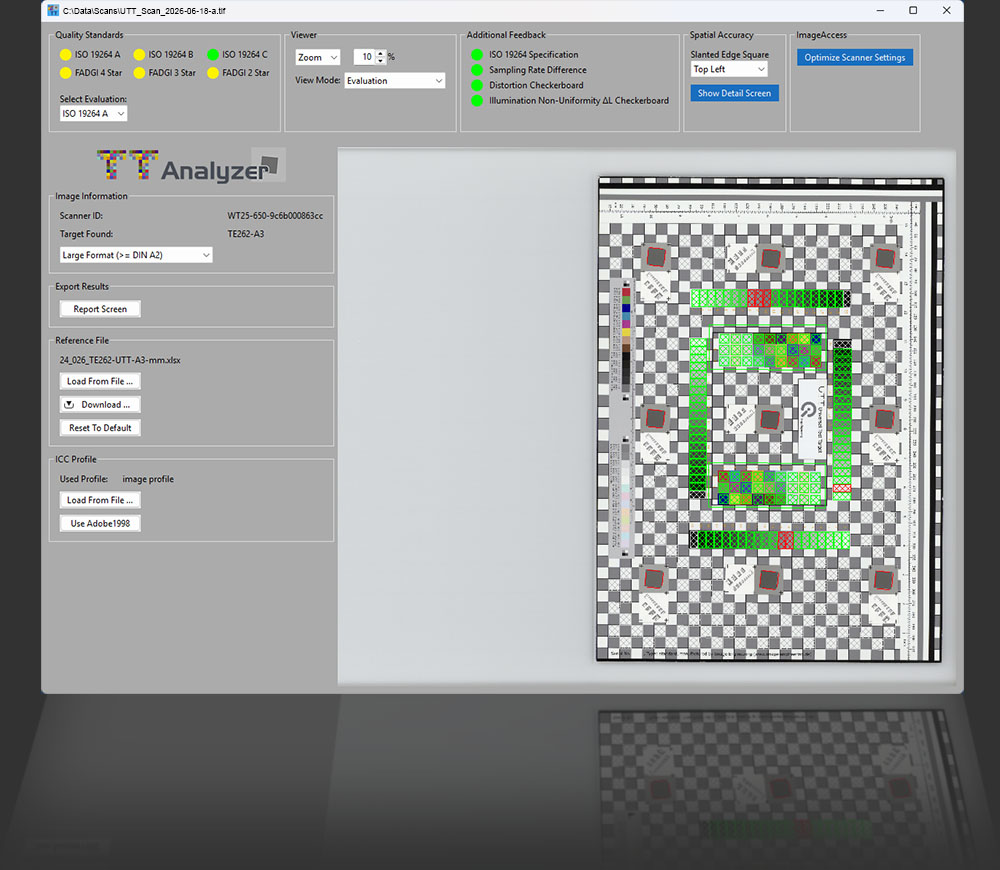
The TT Analyzer software makes scanning quality measurable, reproducible and compliant to standards - in one simple process.
Users can drill into individual measures, including background and greyscale tonal accuracy, white balance, colour accuracy, geometric distortion and sharpness. A detail view charts modulation transfer function (MTF) and edge response. Target-specific reference data can be loaded for greater accuracy, and every parameter remains open for manual fine-tuning.
Where a scan falls short, TT Analyzer converts the deviations into recommended calibration values.
On Image Access WideTEK and BookTEK scanners this step is automatic. A one-click optimisation writes the new values directly into the scanner, configured to suit either FADGI or ISO 19264. Because the settings live in the device rather than in external software, they apply no matter which application starts the scan.
Owners of other scanners take the recommended settings, enter them into the scanner manually, then re-scan the target and re-test. The cycle repeats until the results pass.
Once a scan meets the chosen criteria, TT Analyzer can generate an ISO 19264 or FADGI certificate. Measured and reference values can also be exported side by side as a CSV file for audit and reporting purposes.
A video demonstration of TT Analyzer is available on YouTube.
For further information contact https://www.docuvan.com.au/contact-us/ or call 1300 855 839.